Robotic Knee Replacement in Miami: What the Robot Actually Does
Robotic-assisted knee replacement doesn't replace the surgeon — it gives the surgeon real-time data to make more accurate cuts. Here's what the evidence says about robotic knee replacement.
What "Robotic" Actually Means in the OR
The word "robotic" sets unrealistic expectations. The robot does not perform surgery. The surgeon performs surgery — the robotic arm provides haptic feedback and boundary enforcement that restricts the cutting burr to a pre-planned resection volume.
Before surgery, a CT scan is used to create a 3D model of your knee. The surgical team plans implant size, position, and alignment on this model. In the OR, optical tracking arrays are pinned to the femur and tibia to register the virtual plan to your actual anatomy. As the surgeon prepares the bone, the robotic arm restricts motion outside the planned boundaries — preventing inadvertent over-resection.
The robot enforces the plan. The surgeon makes the plan and makes every decision.
Which Robotic Systems Are Used?
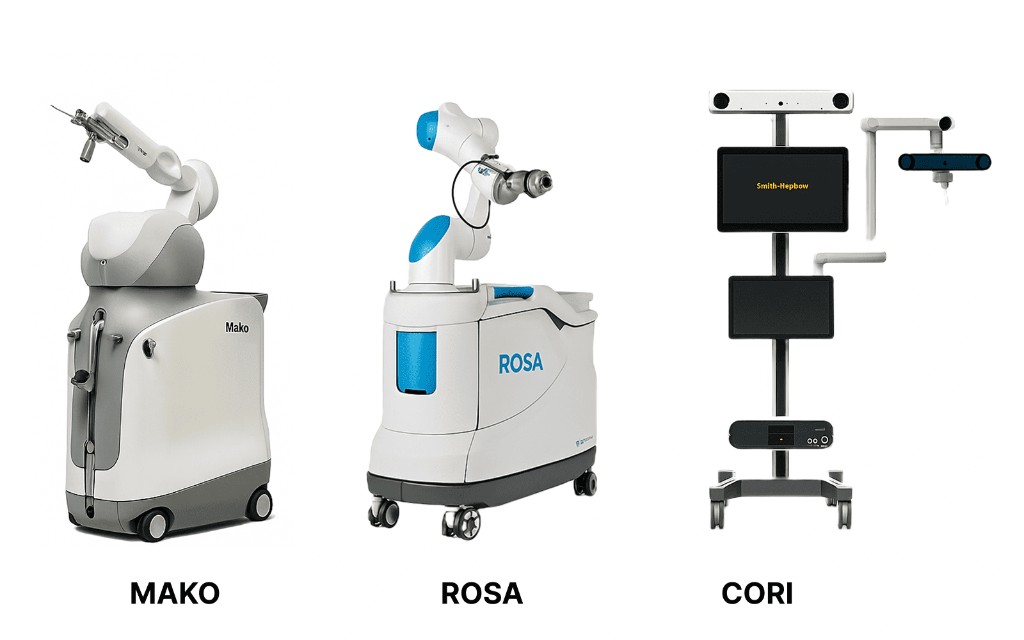
The most widely studied systems in the peer-reviewed literature are:
- Mako (Stryker) — used for partial (UKA) and total knee replacement; arm-based with haptic restriction
- VELYS (DePuy Synthes) — imageless navigation integrated with a robotic handpiece
- Navio (Smith+Nephew) — handheld robotic with imageless planning
At my practice, I select the platform based on the procedure and patient anatomy. For partial knee replacement, the Mako system's preoperative CT planning is particularly valuable for confirming compartment isolation and soft-tissue balance.
What the Evidence Shows
A 2020 randomized controlled trial published in The Bone & Joint Journal found that robotic-assisted UKA resulted in significantly more accurate component positioning and fewer outliers in tibial slope and alignment compared to conventional instrumentation (Bone Joint J 2020;102-B(3):322–331).
For total knee replacement, a 2022 meta-analysis in the Journal of Orthopaedic Surgery and Research concluded that robotic-assisted TKA improved radiographic alignment and reduced the revision rate at short-term follow-up, though long-term data (10+ years) are still accumulating.
What the evidence does not show — at least not definitively — is that every patient needs robotic assistance to have excellent outcomes. Experienced surgeons using conventional techniques achieve comparable results in straightforward anatomy. Robotics adds value most clearly for:
- Complex deformity correction
- Borderline candidates where component positioning accuracy is critical
- Partial knee replacement where small errors in compartment coverage have outsized consequences
Navigation Without a Robot: Is That Different?
Computer navigation uses the same optical tracking to provide real-time alignment data without a robotic arm. Navigation improves alignment accuracy (fewer outliers) but requires additional operative time. It is an evidence-based tool particularly useful in long-leg deformity cases.
Realistic Expectations for Robotic Knee Replacement
Robotic-assisted technology improves the input quality of surgery. It does not override biology — soft tissue healing, bone quality, individual anatomy, and rehabilitation compliance all remain critical.
Patients sometimes ask, "Will the robotic knee last longer?" The honest answer: we don't yet have 15–20 year follow-up data on robotic-assisted cases. Short-term data on component positioning suggests fewer early failures due to malalignment. We will know more as the first generation of robotic cases reaches long-term follow-up.
At my Miami practice, I discuss the specific technology I use at your consultation, explain why I've selected it for your anatomy, and set realistic expectations about what it can and cannot do.
Frequently Asked Questions
Q: Does robotic knee replacement cost more? A: The capital cost of robotic systems is absorbed by the hospital or surgical facility — not billed to the patient or insurer separately. Your insurance covers "total knee replacement" as a procedure code regardless of the technology used.
Q: Is a robotic-assisted knee replacement "better" than a conventional one? A: It depends on the context. In skilled hands with appropriate selection, robotic assistance improves component accuracy. In straightforward cases with an experienced surgeon, the difference may be marginal.
Q: How long does robotic knee replacement surgery take compared to conventional? A: Experienced robotic surgeons perform cases in comparable operative time. The preoperative CT planning takes 20–30 minutes of additional preparation before surgery day.
Q: Is the preoperative CT required for all robotic systems? A: No. Image-based systems (Mako) require a preoperative CT. Imageless systems (VELYS, Navio) use intraoperative registration instead.
Educational information only. Individual candidacy, outcomes, and recovery timelines vary and require medical evaluation.
Written by
Dr. Steven Denyer, MD, MS
Harvard-trained joint replacement surgeon. Specialist in minimally invasive anterior hip replacement, and robotic partial knee and total knee replacement in South Florida.
Share
Keep reading
Partial Knee Replacement
Medial Partial Knee Replacement in Miami: When Only the Inner Compartment Is Worn
Medial partial knee replacement resurfaces only the worn inner compartment, preserving the ACL and healthy tissue. Learn about robotic-assisted UKA candidacy, recovery, and same-da
Read moreReturn to Activity
Golf After Hip and Knee Replacement in Miami and South Florida
If you already golf and arthritis pain is limiting your game, hip or knee replacement is designed to send you back to the course without that pain. Learn how modern techniques supp
Read moreAnterior Hip Replacement
Anterior Hip Replacement in South Florida: What Muscle-Sparing Actually Means
The anterior approach to hip replacement uses an internervous interval between muscles rather than cutting through them. Most patients in my practice do not receive the old list of
Read moreMiami Joint Replacement
Ready to take the next step?
Schedule a consultation with Dr. Denyer to review your imaging and build a personalized surgical plan.
Schedule a Consultation