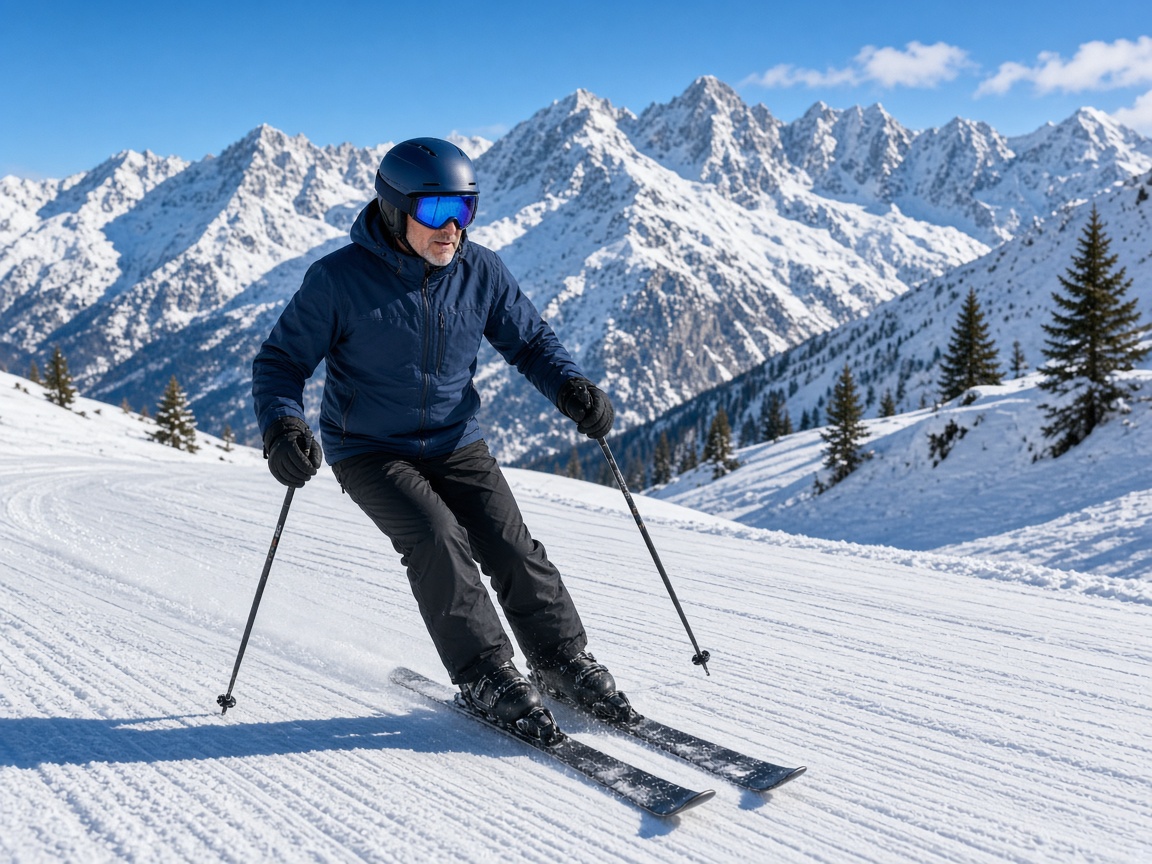
Skiing After Hip or Knee Replacement
If you already ski and arthritis is the only thing hurting, the point of hip or knee replacement is to send you back to skiing without that pain. I do not put lifetime restrictions on the sports you already do.
The point of the operation
Patients at UHealth HSS SoLé Mia, UHealth Boca Raton, and UHealth Tower fly to Colorado, Utah, and the Alps. They are not asking whether I will allow a gentle walk. They are asking whether surgery will end their ski life.
It will not. I do the operation so you can keep the life you already have. If arthritis is what makes the first run of the day hurt, replacing the worn joint is how we take that pain out. Published series of hip and knee replacement patients who were active before surgery commonly return to the same sports, including skiing. That is the outcome I favor, and that is how I counsel you.
National patient pages such as AAOS OrthoInfo sometimes list downhill skiing as higher-demand on an implant. That is a generic caution, not a ban from this practice. I do not tell a skier to retire from skiing because they had an anterior hip replacement or a partial or total knee.
Who goes back — and who does not become a skier overnight
Goes back: You still ski, or you skied last season with pain. You modify terrain because the hip or knee aches, not because you forgot how to ski. After you heal, you go back. Same story for tennis, golf, cycling, swimming, fishing, jogging, and water skiing.
Does not become a first-time skier: You have not been on snow in decades. A new knee will not teach you to ski. Surgery relieves arthritis. It does not hand you a sport you abandoned 30 years ago.
That is the only distinction that matters. It is not "high-impact is forbidden." It is "return to what you already do."
Hip replacement and skiing
Anterior hip replacement — including a bikini incision when it fits — preserves the major muscles around the hip. Most of my anterior-approach patients do not get the old posterior precaution list. That is not a small thing on a ski day: getting in and out of the car, putting on boots, and standing in a lift line are easier when the hip is not bound by 90-degree rules.
I use AI fluoroscopic navigation to set cup position, offset, and leg length. The goal is a hip that feels like your hip when you plant an edge. Many of these cases go home the same day from UHealth.
Knee replacement and skiing
A medial or lateral partial knee, or a patellofemoral replacement, keeps more of your own ligaments. Patients who already ski often describe a more natural knee on snow. If arthritis is in more than one compartment, total knee replacement is the right operation — and TKA patients who skied before go back to skiing too.
I do not tell a runner or a skier that they must switch to swimming forever. If running or skiing was your sport, it stays your sport after the wound and the strength are ready.
Timing is healing, not a lifetime ban
Same-day discharge at UHealth gets you home. It does not put you on a chairlift the next morning. Bone, swelling, and balance need a season of work. A typical skier who was already skiing is planning the next winter, not a permanent retirement.
Before the first trip I want a quiet wound and the strength to get up if you sit down in the snow. Then you ski. Groomed runs to start the first days back is common sense, the same way you would ease into any season — not because I have restricted you for life.
Risks, said calmly
Joint replacement still carries infection, clot, stiffness, fracture around the implant, and wear over time. Skiing adds falls and travel. We lower risk with optimization, antibiotics, clot prevention, and early walking. I do not "protect the implant" by taking away the sport you came in to keep.
Modern replacements are designed as long-term solutions. Large registries report high survivorship into the second decade for many patients, and newer designs are hoped to last longer. Individual results vary. No implant is guaranteed for a set number of years.
Frequently Asked Questions
Q: Will you restrict me from skiing after hip or knee replacement? A: No. If you already ski, the plan is to send you back. I do not impose lifetime activity bans on sports you were already doing.
Q: What if I have not skied in 30 years? A: A new hip or knee will not make you a skier. It can make an arthritic joint stop hurting. The sport has to already be yours.
Q: What about tennis, golf, running, or water skiing? A: Same rule. If that was your sport before the arthritis took over, it stays your sport.
Q: When do I book the trip? A: After we see you healing. Bring the dates. I would rather move a week than pretend the joint is ready the day you leave the hospital.
Further reading
- AAOS OrthoInfo — Activities After Hip Replacement
- AAOS OrthoInfo — Activities After Knee Replacement
- AAHKS patient education
- Mayo Clinic — Knee replacement
If skiing is why you are considering surgery, say so at the visit. That is the outcome we are aiming for. Call 305-243-3000 or request a consultation at miamijointreplacement.com/book.
Educational information from the practice of Steven Denyer, MD, MS. It is not a diagnosis, treatment plan, or a promise of results. Joint replacement is surgery and carries risks. Suitability, recovery, and implant longevity vary. Discuss your own health, imaging, and goals with a qualified orthopedic surgeon before making a decision.
Educational information only. Individual candidacy, outcomes, and recovery timelines vary and require medical evaluation.
Written by
Dr. Steven Denyer, MD, MS
Harvard-trained joint replacement surgeon. Specialist in minimally invasive anterior hip replacement, and robotic partial knee and total knee replacement in South Florida.
Share
Keep reading
Return to Activity
Golf After Hip and Knee Replacement in Miami and South Florida
If you already golf and arthritis pain is limiting your game, hip or knee replacement is designed to send you back to the course without that pain. Learn how modern techniques supp
Read morePartial Knee Replacement
Medial Partial Knee Replacement in Miami: When Only the Inner Compartment Is Worn
Medial partial knee replacement resurfaces only the worn inner compartment, preserving the ACL and healthy tissue. Learn about robotic-assisted UKA candidacy, recovery, and same-da
Read moreAnterior Hip Replacement
Anterior Hip Replacement in South Florida: What Muscle-Sparing Actually Means
The anterior approach to hip replacement uses an internervous interval between muscles rather than cutting through them. Most patients in my practice do not receive the old list of
Read moreMiami Joint Replacement
Ready to take the next step?
Schedule a consultation with Dr. Denyer to review your imaging and build a personalized surgical plan.
Schedule a Consultation